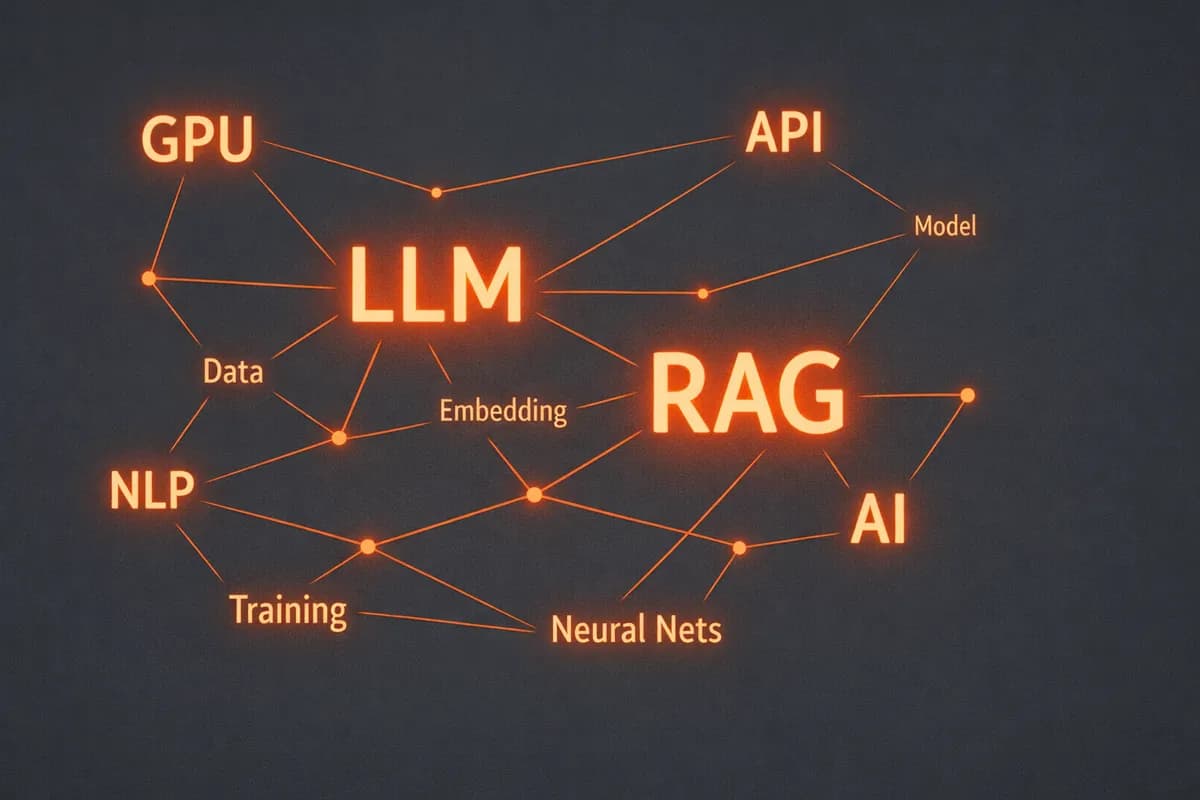
AI buzzwords are flying at you from every direction — LLM, Token, Prompt, Fine-Tuning — and you're nodding along politely while only understanding half of it?
Don't worry. You're not alone. That's exactly why I put this glossary together: all the important terms, clearly explained, without unnecessary jargon.
Bookmark this page. You'll need it.
A
AGI (Artificial General Intelligence)
The big dream: an AI that can do everything a human can. Learning, understanding, being creative, solving problems — in any domain. Some experts say we're still far off, while others make more optimistic predictions.
AI Slop
A derogatory term for low-quality, mass-produced AI content. Generic blog posts, soulless stock photos with six fingers, YouTube videos with robotic narration — all "slop." The term emerged as a reaction to the flood of AI-generated content drowning the internet.
ASI (Artificial Superintelligence)
The next step beyond AGI: an AI that surpasses humans in every domain — not just matches them. Science, creativity, strategy — everything.
Agentic AI / AI Agents
AI systems that can act autonomously — not just answer questions, but independently carry out tasks. An AI agent can research the web, write emails, execute code, and plan multiple steps in sequence. 2025/2026 is widely considered "the year of AI agents." Examples: Claude with Computer Use or specialized coding agents.
Alignment
The problem: how do we teach an AI to do what we actually want? An AI that takes "maximize paperclip production" too literally could theoretically turn the entire world into paperclips. Alignment research ensures AI understands and respects human values.
Anthropic
The company behind Claude. Founded in 2021 by former OpenAI employees, including Dario and Daniela Amodei. Known for its focus on AI safety and "Constitutional AI" — an approach where the AI is trained according to defined principles.
API (Application Programming Interface)
An interface that lets programs talk to each other. When you use an app that "runs on ChatGPT under the hood," that app communicates with AI models through APIs like the OpenAI API. You never see the API — it's the invisible wiring.
Apple Intelligence
Apple's AI features, integrated into iOS, macOS, and iPadOS. Big focus on privacy: a lot runs locally on the device, and when cloud AI is needed, Apple uses "Private Cloud Compute." Features include writing tools, image generation, and Siri improvements. Apple uses a mix of its own models and partnerships (ChatGPT integration).
B
Benchmark
A standardized test for comparing AI models. Think of it as an exam for AI. When a new model drops, everyone looks at the benchmark scores first. Caveat: models can be "overtrained" on benchmarks and still disappoint in practice.
Bias
AI models learn from data. If that data contains biases (and it almost always does), the AI picks them up. A model trained mostly on English text understands English better than other languages. A model that mostly saw photos of white people is worse at recognizing other skin tones. Bias is one of the biggest challenges in AI development.
C
Chain of Thought (CoT)
A technique where the AI "thinks out loud" step by step before giving an answer. Instead of just answering "42," it explains: "First I calculate X, then Y, so the result is 42." This dramatically improves accuracy on complex tasks.
ChatGPT
OpenAI's most well-known AI product. A chat application built on GPT models. You can ask questions, generate text, create images, brainstorm, hold conversations — all in one interface.
Claude
The AI from Anthropic and a major competitor to ChatGPT. Many developers swear by Claude for complex tasks.
Claude Code
Anthropic's official AI coding agent for the terminal. Can independently read, write, and test code, and work with tools like Git. Runs directly in the command line and works with your local file system. Competes with Cursor and GitHub Copilot.
Codex
OpenAI's coding platform — originally a specialized code model, now a full AI coding agent. The Codex CLI is an open-source tool (written in Rust) that runs directly in the terminal: it reads your repo, edits files, runs tests, and can even do code reviews. Under the hood, Codex now uses GPT-5.2-Codex, specifically optimized for agentic coding. Codex supports MCP (Model Context Protocol) for third-party tools, web search while working, and can coordinate multiple sub-agents simultaneously. Install: npm i -g @openai/codex or brew install --cask codex.
Context Window
The amount of text an AI model can "see" at once. Current models advertise 128K to 2 million tokens — but bigger isn't automatically better. The core issue: LLMs are fundamentally text-prediction machines, not databases.
Why bigger ≠ better:
- Lost-in-the-Middle: Stanford researchers showed that models find information at the beginning and end of the context well, but miss facts buried in the middle. Accuracy drops from ~75% to ~55%.
- Context Rot: The more text in the window, the worse the quality gets. The model's attention is a limited budget — every additional token "dilutes" it.
- Context Drift: In long conversations, the model "forgets" earlier instructions or drifts off topic. That's because it predicts patterns, not reasons logically.
Pro tip: Less but more relevant context beats "dump everything in." Techniques like RAG (retrieving only relevant documents) or smart context management deliver better results than just using the biggest context window.
Cursor
An AI-powered code editor built on VS Code. Understands your entire project and can generate, refactor, and explain code. Helped popularize the "Vibe Coding" trend. Uses various models under the hood. One of the most popular tools for AI-assisted software development.
D
DeepSeek
A Chinese AI company that shook the AI world in early 2025. Their R1 model took a radically different approach: instead of relying on standard supervised fine-tuning, R1 was primarily trained through reinforcement learning — the model taught itself to "think" step by step. The results were comparable to OpenAI's o1.
Deep Learning
A subset of machine learning based on artificial neural networks. "Deep" refers to the many layers in these networks. Practically everything we call "AI" today — speech recognition, image generation, ChatGPT — is built on deep learning.
Diffusion Models
The technology behind image generators like DALL-E, Midjourney, and Stable Diffusion. These models learn by gradually destroying images with noise, then learning to reverse that process: creating an image from noise.
Distillation
Transferring knowledge from a large model to a smaller one. The small "student model" learns from the large "teacher model" and often achieves 80-90% of the performance at a fraction of the size. This is how efficient models are created that can run on smartphones or local machines. Many small open-source models are distilled versions of larger ones.
GDPR (General Data Protection Regulation)
The EU's data protection law — and a global benchmark for privacy regulation. Hugely relevant for AI: Where is your data processed? Are conversations used for training? Many companies need GDPR-compliant AI solutions (European servers, no training on user data, data processing agreements). Even if you're outside the EU, GDPR often applies if you handle EU user data. OpenAI, Anthropic, and others offer enterprise plans that address these requirements.
E
Embedding
A method of representing words or text as numbers. Similar concepts get similar numbers. "King" and "queen" are close together; "king" and "apple" are far apart. This lets AI systems understand the meaning of text, not just the letters.
F
Fine-Tuning
Further training a base model on your own data so it gets better at specific tasks. A company might fine-tune a model on its customer support emails so it responds in the company's voice and tone.
Foundation Model
The large base models (GPT, Claude, etc.) that everything else is built on. They were trained on massive amounts of data and can then be adapted for various tasks.
G
Gemini
Google's AI model, competing with OpenAI's GPT and Claude. Integrated into Google products like Google Docs and Gmail. Used to be called "Bard."
GPT (Generative Pre-trained Transformer)
OpenAI's model family. "Generative" means it can create content. "Pre-trained" means it was trained on massive datasets beforehand. "Transformer" is the underlying architecture.
GPU (Graphics Processing Unit)
Graphics cards — originally built for video games, now the backbone of the AI revolution. GPUs can run thousands of calculations in parallel, perfect for neural networks. NVIDIA dominates the market; their chips are so in-demand that companies wait months for deliveries. No GPUs, no modern AI training.
Grok
The AI from xAI (Elon Musk's AI company). Integrated into X (Twitter) and known for a "edgier" tone with fewer restrictions than other models.
Guardrails
Safety mechanisms that prevent an AI from producing unwanted outputs. Can be implemented at various levels: in the model itself (training), in the system prompt, or as a separate filter layer. Guardrails block things like illegal content, hate speech, or the disclosure of trade secrets. Essential for enterprise applications.
H
Hallucination
When an AI confidently states things that are flat-out wrong. It "invents" facts, quotes, even scientific studies. This happens because the model is trained to generate plausible-sounding text — not necessarily true text. Always double-check!
I
Inference
The process of actually using a trained model. When you ask ChatGPT a question, the model performs "inference" — applying what it learned to generate a response. Inference costs compute, and compute costs money.
J
Jailbreaking
Attempts to bypass an AI's safety restrictions. Providers constantly work to block these tricks.
L
Llama
Meta's (Facebook's) open-source model family. Free to use and customize.
LLM (Large Language Model)
Large Language Models — what we casually call "AI." OpenAI's GPT, Claude, Llama, Gemini — all LLMs. They were trained on enormous amounts of text and can understand and generate language. "Large" refers to the billions of parameters (numbers) they're made of.
Lovable
An "AI App Builder" — you describe in plain English what app you want, and Lovable generates working code with a UI. Part of the new wave of no-code/low-code tools democratizing software development. Similar tools: Bolt, v0, Replit Agent.
M
Make (formerly Integromat)
A visual automation platform. You connect different apps and services via drag-and-drop into "scenarios": when an email comes in, extract the content with AI, save it to a database, and send a Slack message. Powerful tool for AI workflows without coding. Competitors: n8n, Zapier.
Midjourney
One of the most popular AI image generators.
Model
In the AI context: the trained system that can perform tasks. A "model" is the result of training — billions of numbers that together understand how language works. GPT-5 is a model. Claude Opus 4 is a model.
MoE (Mixture of Experts)
An architecture where a model consists of many specialized "experts." For each request, only a few experts are activated — saving compute. A MoE model with 400 billion parameters might only use 17 billion per request. Llama 4, Mixtral, and many modern models use MoE. It's the reason models can keep getting bigger without costs exploding.
Multimodal
A model that can handle different media types — text, images, audio, video. GPT can analyze images and process audio.
N
n8n
An open-source automation platform, especially popular for AI workflows. You can self-host it or use the cloud version. Connects hundreds of apps and has native AI integrations. Many people use n8n to build their own AI agents without needing to code.
Nano Banana
Google's viral image generator (officially "Gemini 2.5 Flash Image"). The name started as a 2:30 AM inside joke — and it stuck. In August 2025, "nano-banana" appeared anonymously on LMArena and immediately hit the highest ELO rating of all time.
Natural Language Processing (NLP)
The umbrella term for everything related to computer-based language processing. Translation, text analysis, chatbots — all NLP.
Neural Network
A brain-inspired computing system. Made up of connected "neurons" (mathematical functions) that process information. The foundation of deep learning, and therefore practically all modern AI.
No-Code Tools
Software that lets you build apps, websites, or automations without writing code. Especially relevant in the AI era: tools like Make, n8n, Lovable, or Zapier enable complex AI workflows via drag-and-drop. You no longer need a CS degree to put AI to work.
NVIDIA
The company powering the AI revolution. NVIDIA's GPUs are the gold standard for AI training and inference. Nearly every major AI model was trained on NVIDIA hardware. That makes NVIDIA one of the most valuable companies in the world. CEO Jensen Huang is a key figure in the AI industry.
O
OCR (Optical Character Recognition)
Text recognition in images. Scans a photo, PDF, or screenshot and extracts the text. Used to be standalone software; now baked into many AI models. GPT-5, Claude, and other multimodal models can do OCR on the fly — just send an image and ask for the text.
One-Shot Learning
Like few-shot, but with just one single example. "Here's a product description in my style. Now write one for this other product." The fact that this works at all shows how well modern LLMs recognize patterns.
OpenAI
The company behind ChatGPT and GPT-5. Founded as a non-profit, now one of the most valuable AI companies in the world.
Open Source
Software whose source code is public and can be used and modified by anyone.
Orchestration
Coordinating multiple AI components into a unified system. An orchestration layer decides: which model answers this question? Do we need a web search? Should an agent be activated? Tools like LangChain, n8n, or custom code handle orchestration. Critical for complex AI applications.
Overfitting
When a model has essentially memorized its training data instead of learning general patterns. It works perfectly on known data but fails on new inputs. Like a student who memorizes answers instead of understanding the underlying concept.
P
Parameter
The "dials and knobs" of a model — numbers that get adjusted during training.
Post-Training
Everything that happens after pre-training. This is where the "raw" model gets refined: RLHF (human feedback), safety training, instruction tuning (learning to follow directions). Post-training turns a text-prediction system into a helpful assistant. It's why ChatGPT responds politely instead of just completing text.
Pre-Training
The first and most expensive phase of model training. The model learns from massive amounts of text (books, websites, code) to predict the next word. In the process, it develops an "understanding" of language, facts, and logic. Pre-training costs tens of millions of dollars and takes months on thousands of GPUs. Post-training follows.
Prompt
The input you give an AI model. Your question, your instruction, your text. A good prompt leads to better results.
Prompt Engineering
The art of crafting prompts to get optimal results. Sounds simple, but it's a real skill. Good prompt engineers command serious pay.
Q
Quantization
A technique to make models smaller and faster. Instead of storing numbers at 32-bit precision, you use 16, 8, or even 4 bits. This halves or quarters the memory needed. A 70B model that normally requires 140 GB can fit on a 24 GB GPU when quantized. The quality loss is often minimal. Formats like GGUF and methods like QLoRA make quantization accessible.
R
RAG (Retrieval-Augmented Generation)
A technique to reduce AI hallucinations. Instead of relying solely on its training, the AI first searches relevant documents and bases its answer on those sources. Essential for enterprise applications where accuracy matters.
Reasoning Models
Models that "think" before they answer — using chain of thought that can run internally for minutes. What started as a niche with OpenAI's o1 in late 2024 has become the norm: virtually all new frontier models can "reason."
The key reasoning models:
- OpenAI o3 / o4-mini: o3 hit 91.6% on AIME (math competition). o4-mini delivers similar performance at a fraction of the cost.
- DeepSeek R1: The open-source breakthrough. Comparable performance to o1, released as open source. Proved that reasoning via reinforcement learning works without expensive supervised fine-tuning.
- Claude (Extended Thinking): Anthropic's hybrid approach — Claude can respond both instantly and with extended deliberation, no model switch needed.
- Google Gemini "Deep Think": Google's reasoning mode, introduced with Gemini 3 (November 2025).
Why this matters: Reasoning models mark a paradigm shift — instead of just throwing more training data at the problem ("pre-training scaling"), compute time at inference is now being scaled too ("inference-time scaling"). More thinking time = better answers. That said, there's skepticism: Apple researchers argue in "The Illusion of Thinking" that even reasoning models just simulate patterns without true understanding.
Reinforcement Learning from Human Feedback (RLHF)
How models like ChatGPT get "trained up." Humans rate the model's responses, and the model learns to prefer answers that get good ratings. That's why ChatGPT is polite, helpful, and cautious.
S
Sora
OpenAI's video generation model. You describe a scene, and Sora creates a realistic video from it. Sora 2 (2025) added synchronized sound and a TikTok-like app. Its biggest competitor is Google's Veo 3 (see Veo), which stands out with native audio integration and 4K resolution. Other competitors: Runway Gen 4, Pika, Kling. The space is growing fast — major studios are integrating AI video into standard workflows.
Speech-to-Text (STT)
Speech recognition — converting spoken language to text. OpenAI's Whisper is the best-known model and free to use. The foundation for dictation features, meeting and podcast transcription, or voice control.
Speech-to-Speech (STS)
Direct speech-to-speech communication, skipping the text step entirely. ChatGPT can do this: you speak, the AI "hears" the nuances of your voice, and responds directly with spoken language — with natural pauses, emotions, and interruptions. Feels like a real conversation.
Stable Diffusion
An open-source image generator. Can run on your own computer (with a decent GPU). Very flexible and customizable, making it popular with technically-minded users.
Scaling Laws
The discovery that AI models get predictably better when you make them bigger: more parameters, more data, more compute. These "scaling laws" kicked off the AI boom — suddenly people knew: invest more = better results.
Synthetic Data
Training data generated by AI.
System Prompt
Hidden instructions given to the AI before your actual prompt. Developers use system prompts to steer the AI's behavior: "You are a friendly customer service assistant for a bank. Always respond professionally and helpfully."
T
Temperature
A setting that controls how "creative" or "random" the output is. Low temperature (0.1) = consistent, predictable, good for facts. High temperature (0.9) = creative, surprising, sometimes incoherent. For most tasks, 0.3-0.7 is the sweet spot.
Text-to-Speech (TTS)
Converting text into spoken language. Modern TTS models like ElevenLabs or OpenAI's TTS sound remarkably human — with emotions, pauses, and natural rhythm. Used for audiobooks, video voiceovers, accessibility, and voice assistants.
Token
The unit AI models use to process text. Not quite a word, not quite a character. "Artificial intelligence" is about 4 tokens. Important because AI APIs charge by the token.
Training
The process where a model learns from data. GPT-5 was trained on massive amounts of text from the internet — books, websites, Wikipedia, code. Training is extremely expensive: training a large model costs tens of millions of dollars in compute.
Transformer
The architecture behind virtually all modern AI models. Introduced in 2017 by eight Google Brain researchers in the paper "Attention Is All You Need" (NeurIPS 2017). The breakthrough: the attention mechanism lets the model consider all other words in the text simultaneously when processing any given word. Unlike the previous RNN/LSTM architectures, the Transformer can work massively in parallel, which made training on large datasets feasible in the first place. No Transformer, no GPT, no Claude, no Gemini — and no modern computer vision or speech synthesis either. Fun fact: all eight authors have since left Google and founded their own companies.
V
Vibe Coding
A term (coined by Andrej Karpathy) describing how people code with AI assistants: you roughly describe what you want, the AI generates code, you test, give feedback, and iterate — without understanding every line yourself. "Programming by vibes." Controversial: some see it as democratization, others as a risk.
Vector Database
A database optimized for embeddings. Essential for RAG systems. Enables fast searches by similar meaning, not just identical words.
Veo
Google's video generation model (from DeepMind), the biggest competitor to OpenAI's Sora. Veo 3, announced at Google I/O 2025, sets the current standard: 4K videos with natively synchronized dialogue, music, and ambient sound — all from a single text prompt, no post-production needed. The follow-up Veo 3.1 further improved cinematic quality and creative controls. In benchmarks, Veo 3.1 outperforms Sora 2, Runway Gen 4, and other competitors on complex multi-element prompts. Pricing is steep though (up to $249/month, limited videos per day).
W
Weights
The learned numerical values of a neural network that determine how strong individual connections between neurons are — comparable to synapses in the brain. Weights and biases together make up the "parameters" of a model. During training, they're adjusted step by step (via backpropagation) until the model makes good predictions. When someone says "download a model's weights," they mean the billions of numbers that make up the model — essentially the model's entire "knowledge" in numerical form. For open-source models like Llama or DeepSeek R1, these weights are publicly available.
X
xAI
Elon Musk's AI company, founded in 2023. Develops the Grok models and has access to data from X (Twitter). Known for aggressive scaling — xAI operates one of the largest GPU clusters in the world. Positions itself as a "less censored" alternative to OpenAI.
Wrapping Up
AI is evolving fast, and the vocabulary is evolving with it. This list will definitely need updating before long. But for now: if you understand these terms, you can hold your own in any AI conversation.
Missing a term? Let me know — I'll add it.